
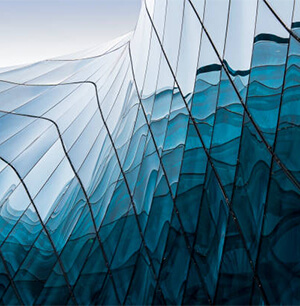


When discussing detailing, performance or specification, precision in terminology matters – particularly when coordinating with engineers, consultants and contractors. Understanding this distinction is important in both academic and professional contexts. While many assume the façade refers only to the “front” of a building, it can describe any external elevation, particularly those facing public space. Cost is a constant pressure, since high-performance materials and complex detailing add up quickly. The best choice depends on the building’s location, climate, budget, and desired aesthetic effect. The most popular facade materials include glass, concrete, brick, natural stone, steel, aluminum, wood, and composite panels.
The selection of architecture facade materials significantly influences both aesthetics and performance. According to Allied Market Research, the global facade market is projected to reach $589 billion by 2034, driven by the growing demand for sustainable and energy-efficient facade of buildings. Let us tell you it starts with a clear understanding of both function and visual storytelling.
It’s not just the building’s exterior; it shapes the character and functionality of the entire structure. Whether it’s optimizing for energy efficiency or incorporating modern technologies, these tips will provide a comprehensive roadmap for achieving architectural excellence. Architectural facade design significantly influences the aesthetics, energy efficiency, and functionality of modern buildings through careful material selection. By analyzing context, developing strong concepts, and using the right architecture facade materials, architects can transform ordinary structures into visual landmarks.
Rejecting orthogonal geometry, the museum seamlessly merges art, architecture, and public interaction, redefining the concept of a cultural institution. Amidst Baroque and Medieval surroundings, it bridges past and future, standing as a testament to the city’s cultural ambitions. The Kunsthaus Graz, designed by Peter Cook and Colin Fournier, boldly redefines contemporary architecture in a historic city. Many of these elements are rooted in heritage-based practices, yet over time, they have been reimagined and transformed through new processes, giving rise to contemporary architectural expressions.
Step 1: Understand the Project Context
Their appearance exhibits a specific Venetian vernacular that has stood the test of time and stands as a backdrop for the city’s contemporary activities. MVRDV’s facade introduces variation across the elevations and marks the locations of the communal green spaces on the 24th floor and the rooftop. The scheme builds on the modular system developed by ADDP Architects, who designed the buildings using Prefabricated Prefinished Volumetric Construction (PPVC). Two 36-storey residential towers have been completed on Irwell Bank Road in Singapore, featuring a pixelated facade designed by MVRDV. Conceived as a “3D neighbourhood,” the design breaks the large volume into a series of colourful, distinct blocks that incorporate numerous references to Rotterdam’s architectural character. Designed for developer LSI, who markets the project as The Bluezone Offices, the building will occupy a narrow site along the railway line, reaching 61 metres in height and extending almost 150 metres in length.
Understanding Architectural Façade Design
- Designing a unique facade merges art, engineering, and technology to create structures that inspire and perform efficiently.
- By understanding the critical aspects of facade design, we can create buildings that are both aesthetically pleasing and highly functional.
- Proper insulation materials, double-glazed windows, and external shading devices enhance thermal performance and maintain a consistent indoor climate.
- Their project emphasizes the use of historical insights to guide the facade design process, ensuring a balance between old and new.
- Common features include brickwork, stone cladding, ornate detailing, and symmetrical designs.
The design facade building process begins with understanding the local context, climate, culture, and neighboring structures. Advanced glass technologies, such as double glazing and reflective coatings, have improved energy efficiency and sustainability. They age well, carry cultural meaning, and remain popular for residential and heritage projects where context and craftsmanship matter as much as novelty.

A building façade for films serves a different purpose—it must look convincing on camera while often being temporary or constructed at a fraction of the cost. Modern home facade design increasingly incorporates green technologies such as photovoltaic cladding, double-skin facades, and eco-friendly materials that reduce a building’s carbon footprint. Impressive facade not only has a beautiful exterior but it also has high quality energy efficient features inside the home.
What is the Difference Between a Building Elevation and a Building Facade?
In contemporary urban landscapes, façades must be practical and visually striking. As architects, we know that the facade is not just the exterior skin of a building but a crucial element that influences light exposure, energy efficiency, and overall aesthetic appeal. As you would have gathered, we are here to help you take the industry by storm with advanced, tech-first skills. Designed with crystalline glass panels, this structure transforms with light https://starruby.info/author/starruby/page/21/ and color, offering an artistic facade that expresses a building inspired by Iceland’s natural landscapes. Integrating vertical gardens and reflective heliostat mirrors, this project merges ecology with architecture, redefining what sustainable facade of buildings can achieve. A well-designed facade seamlessly integrates with the structural framework and mechanical systems.
Adding vertical gardens or green walls to façades not only improves air quality but also brings a touch of nature into urban settings, enhancing the well-being of occupants and passersby. Choosing materials that complement the local climate and existing urban fabric can improve durability and aesthetic cohesion. They contribute to energy efficiency by regulating heat and light, thus reducing reliance on artificial systems.

Similarly, principles of biomimicry can inspire https://www.mlb4s.com/squire-creates-operating-system-for-neighborhood-barbershops.html?noamp=mobile innovative building facade designs that emulate nature’s efficiency, creating facades that self-shade like leaves or ventilate like termite mounds. Its double-skin curtain wall incorporates two layers of glass with a ventilated cavity for natural ventilation, reducing the need for mechanical cooling. Its triple-glazed windows, combined with advanced shading devices, minimise heat loss during colder months and prevent overheating in warmer seasons.
- Additionally, advancements in material science have led to the development of smart facades that adapt to environmental conditions, optimizing energy efficiency.
- As technology evolves, architects and designers are continually exploring new trends and innovations to create high-performance building facades that could blend form and function.
- A façade refers to the entire external face or envelope of a building, including structure, insulation, glazing and external finishes.
- Situated in Denmark, this residential building designed by Henning Larsen Architects is inspired by the characteristics of the fjord, mimicking wave-like shapes.
- Parametric designs leverage algorithmic thinking to create complex, adaptive structures.
- Inspired by experimental solar houses developed after the 1970s oil crisis, the Passive House certification emerged in the late 1980s as a response to growing concerns about energy efficiency and the environmental impact of the construction industry.
Innovative façades around the world showcase how creativity and technology converge in modern architecture. Engineers and architects collaborate to ensure the facade supports load distribution, insulation, and energy efficiency without compromising aesthetics. Combining glass with stone or metal can achieve a balanced look that is both modern and timeless. Situated in Denmark, this residential building designed by Henning Larsen Architects is inspired by the characteristics of the fjord, mimicking wave-like shapes. Below are four projects that demonstrate different approaches to façade design – from environmental optimisation to cultural integration. Unitised systems allow faster installation and improved quality control but require early coordination and higher upfront manufacturing costs.